Gravity Roller Shelf vs Traditional Shelf for Refrigerators & Retail Displays
Compare gravity roller shelves and traditional retail shelves for supermarkets, beverage coolers, and refrigeration displays. Learn differences in product visibility, labor efficiency, ROI, and retail merchandising performance.
Retail shelving systems directly affect product visibility, restocking efficiency, and sales conversion. While traditional flat shelves have long been used in supermarkets and refrigeration cabinets, gravity roller shelves are increasingly becoming the preferred solution for beverage brands and modern retail environments.
This article provides a detailed comparison between gravity roller shelves and traditional shelving systems, helping retailers, brand owners, and equipment manufacturers make informed decisions.
1. Basic Structural Differences
Gravity Roller Shelf
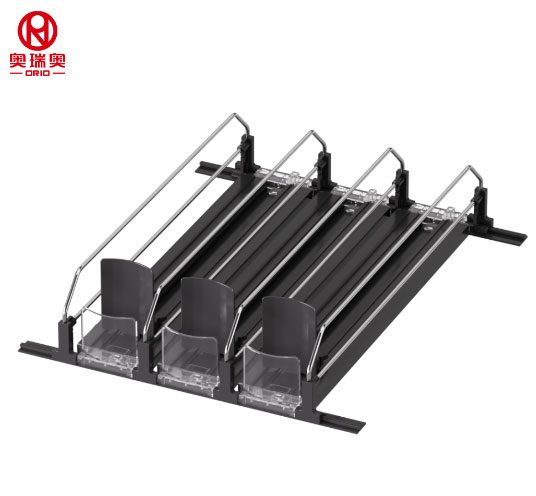
A gravity roller shelf uses inclined roller tracks that allow products to automatically slide forward after one item is removed. The system relies on gravity, eliminating the need for manual front-facing.
Core components include:
Roller tracks
Adjustable lane dividers
Reinforced metal frame
Front stopper
Optional pusher guides
Traditional Shelf
A traditional shelf is a flat metal or wire platform installed horizontally inside a cabinet or display rack. Products remain stationary and require manual arrangement.
It typically includes:
Flat steel or wire shelf panel
Fixed brackets
No moving components
The fundamental difference lies in automation and display control.
2. Product Visibility Front-Facing Performance
Gravity Roller Shelf Advantage
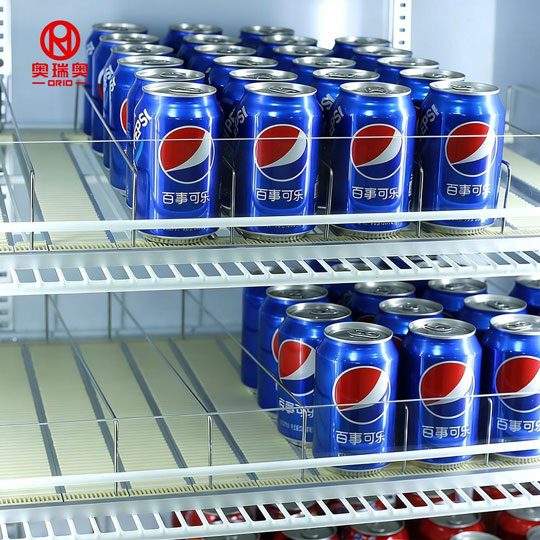
Gravity roller shelves automatically maintain front-facing alignment. When a customer removes one product, the remaining items slide forward to fill the space.
Benefits include:
Always-full appearance
Improved visual merchandising
Reduced labor for staff
Stronger impulse purchase stimulation
This is especially effective in beverage coolers and refrigerated displays.
Traditional Shelf Limitation
Traditional shelves require employees to manually pull products forward multiple times per day. Without regular adjustment:
Gaps appear
Products shift backward
Display looks messy
Sales may decline
In high-traffic stores, maintaining front alignment becomes labor-intensive.
3. Labor Efficiency Comparison
Retail labor cost is rising globally.
Feature
Gravity Roller Shelf
Traditional Shelf
Auto front-facing
Yes
No
Restocking time
Reduced
Standard
Daily maintenance
Minimal
Frequent
Staff workload
Lower
Higher
For chain supermarkets and beverage brands managing multiple outlets, gravity roller shelves significantly reduce operational labor hours.
4. Space Utilization SKU Flexibility
Gravity Roller Shelf
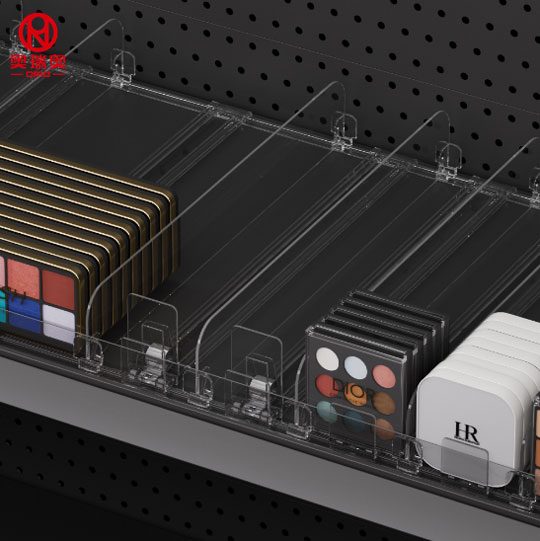
Adjustable lane width
Optimized product alignment
Better depth utilization
Reduced dead space
The lane divider system allows flexible configuration for different bottle or can sizes.
Traditional Shelf
Fixed flat surface
No lane separation
Mixed product placement
Lower display precision
Retailers carrying multi-size SKUs often experience product disorder with flat shelving.
5. Performance in Refrigerated Environments
Gravity roller shelves are specifically engineered for:
Low temperature conditions
Condensation resistance
Cold-resistant rollers
Anti-corrosion frames
High-quality systems maintain smooth sliding even in commercial refrigerators and freezer cabinets.
Traditional shelves perform structurally well in cold environments but do not improve product movement or alignment.
6. Load Capacity Durability
There is a common misconception that traditional shelves are stronger. In reality:
High-quality gravity roller shelves feature:
Reinforced steel frames
Heavy-duty roller tracks
High-load capacity per lane
Uniform weight distribution
For beverage bottles and canned drinks, properly designed gravity roller systems provide sufficient structural support.
However, low-quality gravity shelves may use thin materials, reducing durability. Supplier selection is critical.
7. Cost Comparison
Initial Investment
Traditional shelves are cheaper upfront due to simple structure.
Gravity roller shelves have higher initial cost due to:
Roller mechanism
Adjustable divider system
Reinforced structure
Long-Term ROI
Gravity roller shelves offer:
Labor cost reduction
Increased product visibility
Higher sales conversion
Lower replenishment frequency
Reduced display management
For high-volume retail environments, ROI often justifies the investment.
8. Sales Impact Consumer Behavior
Studies in retail merchandising show that:
Full-looking shelves increase purchase confidence
Front-facing products improve impulse buying
Organized displays strengthen brand image
Gravity roller shelves maintain consistent visual impact throughout the day.
Traditional shelves often lose display effectiveness during peak hours.
9. When to Choose Gravity Roller Shelf
Gravity roller shelves are ideal for:
Beverage coolers
Supermarkets
Convenience stores
Brand display refrigerators
High-turnover products
Multi-SKU retail environments
They are particularly beneficial when:
Labor cost control is a priority
Display quality affects brand perception
Shelf management efficiency matters
10. When Traditional Shelves Are Suitable
Traditional shelves remain practical for:
Low-turnover products
Storage-only areas
Warehouse racks
Non-display cold storage
Budget-limited projects
If display presentation is not a key factor, flat shelves may be sufficient.
11. Final Comparison Summary
Criteria
Gravity Roller Shelf
Traditional Shelf
Auto front-facing
Yes
No
Labor saving
High
Low
Visual merchandising
Excellent
Basic
SKU organization
Structured
Flexible but messy
Initial cost
Higher
Lower
Long-term ROI
Higher
Moderate
Best for
Retail display
Storage use
Which Shelf System Should You Choose?
Choose Gravity Roller Shelves If:
• You operate beverage coolers
• Product visibility affects sales
• Labor cost reduction matters
• You manage multiple SKUs
• You need premium retail presentation
Choose Traditional Shelves If:
• The area is used mainly for storage
• Product display is not important
• Budget is extremely limited
• Products have low turnover
Typical ROI of Gravity Roller Shelves
Although gravity roller shelves have a higher upfront investment, many supermarkets and beverage brands recover the cost through:
• Reduced labor expenses
• Faster replenishment
• Improved product visibility
• Increased impulse purchases
For high-turnover beverage displays, ROI is often achieved within 6–18 months depending on store traffic and product volume.
Conclusion
Choosing between a gravity roller shelf and a traditional shelf depends on your business objectives.
If your priority is:
Maximizing retail sales
Maintaining premium product presentation
Reducing staff workload
Improving operational efficiency
Then a gravity roller shelf system is the more strategic investment.
For storage-only applications with minimal display requirements, traditional shelves remain functional.
For retailers, beverage brands, and refrigeration equipment manufacturers seeking competitive differentiation, upgrading to gravity roller shelf systems delivers measurable operational and commercial advantages.
Need Help Choosing the Right Shelf System?
Our engineering team can help you evaluate gravity roller shelf and traditional shelf solutions based on:
• Product dimensions and weight
• Refrigerator cabinet structure
• Retail traffic volume
• SKU layout requirements
• Refrigeration environment
• Budget and ROI targets
We provide:
• OEM gravity roller shelf customization
• Technical drawings and CAD support
• Load testing reports
• Refrigerator compatibility analysis
• Bulk production solutions
Contact us today to discuss your retail refrigeration project.